Regulating emotions not only helps a person to be able to deal with a situation but also allows them to “effectively manage and respond to an emotional experience.” (Rolston, n.d.). Without emotional regulation, trying to manage all the stressful and overwhelming emotions in one’s life can prove difficult. Trying to calm yourself when becoming overwhelmed by things such as sounds, smells, or other inputs that can stimulate an individual can become hard without proper emotional regulation skills, especially for those with life challenges such as Autism, ADHD, “Asperger’s,” anxiety, etc., but with the appropriate help, these skills can usually be taught.
In a place like college, everything can be overstimulating. Whether it be the scent of the dining hall, your roommate or people on your floor being too loud when you’re trying to focus, or even just too many people being around you at once, things can become stressful very quickly. This is when it is vital for young adults to be able to soothe themselves on their own, since typically, they are away from home, so their parents or family cannot aid them like they may be used to, which is why they must be able to on their own. Knowing when it is time to take a step back and assessing which behavior is appropriate for the situation is a way young adults can attempt to self-regulate. Tactics such as specific types of breathing strategies, “rethinking a challenging situation to reduce anger or anxiety, hiding visible signs of sadness or fear, or focusing on reasons to feel happy or calm” are ways young adults with can self-regulate (psychologytoday, n.d.). College requires students to get up and present in front of a class of a hundred people, experience new sensory stimuli such as perfumes and other smells people bring with them, as well as differing opinions and points of view that may conflict with their own. Having so much going on can quickly become difficult to manage along with all the schoolwork and the social life young adults are trying to balance, which is why regulating your emotions in times that may be more troubling than others is essential. Lashing out because you are stressed or pushing off work because you are feeling down is not typically as accepted in college as it might be in high school. Being a young adult in a place that requires you to become independent comes with being able to take responsibility, and it can be hard to do so if your emotions are all over the place.
When speaking to a client, they would speak about how hard regulating their emotions could be in college, especially with everything going on. They felt as if they could not escape anything, because if it wasn’t the sound of their roommate playing music too loud, it was the strong smell of cleaning products used to clean the bathroom, and even without that, schoolwork and missing home would make their emotions overwhelming. They would feel like they were constantly on edge and on the verge of snapping at anyone who would do anything as minor as accidentally bumping into them or disagreeing with their perception of a situation, which is when they realized they needed to take a step back. From there, they would learn to focus their attention on their happy place or pleasant memory. They could see themselves with their friends at a nice restaurant to try and manage the situation they are in before eventually responding in a way that was (hopefully) appropriate, which successfully helped them manage their emotions.
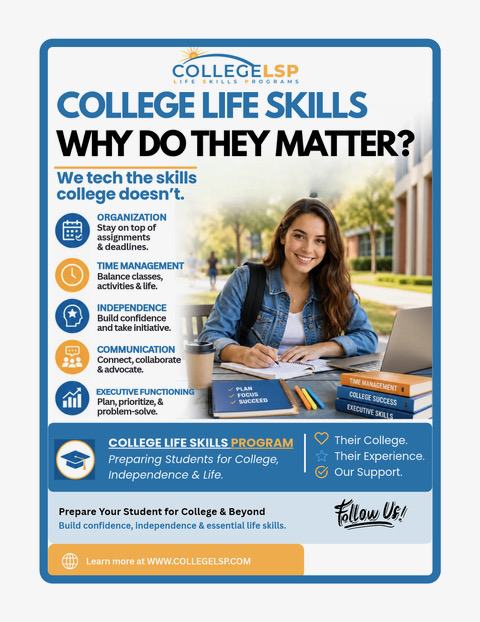
At the College Life Skills Program, we help those who are college bound, in college, and even those after college learn the importance of self-regulation skills and how to implement them into their lives to ensure a happy and healthy integration into newly found young adult independence. Our team of Doctoral and Master level professionals uses our individualized, proprietary, evidence-based approaches developed with the real-life experience of thousands of students over three decades to aid young adults in their journey into adult life. So, if your young adult is having trouble achieving adult-level emotional regulation skills, the CollegeLSP is more than qualified to help.
Dr. Eric J. Nach, Ph.D., M.Ed., A.S.D.C., is a Developmental and Behavioral Specialist who specializes in Autism, ADHD and related disorders. Dr. Nach is the founder of the College Life Skills Program where he and his team of professional’s help develop the Emotional Maturity, Executive Functioning, Life Skill and Social Abilities of college students and those high school students preparing for college. The CollegeLSP is a subsidiary program of the Support For Students Growth Center, located in Boca Raton, FL and providing services nationwide.
Sussex Publishers. (n.d.). Emotion regulation. Psychology Today. Retrieved October 31, 2022, from https://www.psychologytoday.com/us/basics/emotion-regulation
Self-Injury & Recovery Resources (SIRR). The Cornell Research Program on Self-Injury and Recovery. (n.d.). Retrieved October 31, 2022, from http://www.selfinjury.bctr.cornell.edu/