For one young woman, identifying emotions was never her strong suit. Whether it be her own or her friends, knowing when or how her peers were feeling felt difficult for her. Unless someone openly told her exactly what they were thinking, she always assumed everyone was content with things, but as she got to college, she realized that wasn’t the case. She quickly noticed that her roommate didn’t talk much, and when she did, she couldn’t tell if she was happy, sad, or mad from the tone of her voice. This then led her to assume that she was always in a decent mood, but as time went on, her roommate sat her down and told her that she wishes she’d be a little more aware of what she was feeling since when having a difficult day, she likes to be alone.
Despite never openly explaining that she had a bad day or was upset, the young woman tried to do as her roommate asked, but as time went on, she realized she couldn’t tell when her friends’ emotions were changing, and not only when it came to her roommate, but others as well. She felt as if she was never in tune with her friends’ emotions, which could sometimes cause her to be insensitive to them as well, and as the semester continued, she felt discouraged by this. So much so she even started not getting out of bed, going to class, cleaning up, and even showering, causing her roommate to point out that she may be suffering from depression.
As the young woman comes to terms with this, she realizes that she cannot only not identify her friend’s emotions, but her own at times. Without her parent’s help, she felt as if trying to be emotionally intelligent was too difficult of a task, and as she began cutting off her friends and not attending class, her family got a notice that she was put on academic probation, and if she didn’t fix her grades, she’d be at risk for being kicked out of college. This then worried her parents who have spent a lot of time and money getting her to where she was now, and when discussing it with her, they realized her main problem was her inability to identify the emotions of others (Theory of Mind) on an adult level and get help independently when she needed it (self-advocating).
When in such an emotion-inducing place like college, it is crucial for young adults to have the ability to identify what they are feeling. Despite college having a stigma of being the best time of an individual’s life, it also has its downsides. Being away from home for the first time, doing heavy coursework, not getting enough sleep, not getting along well with your roommate or peers, struggling to make friends, and so much more can cause young adults with or without neurodiversity’s to feel negative emotions. Stress, anxiety, depression, and other mental health issues are typically not uncommon for college students to face, and with the sudden change in lifestyle and life overall, it can cause these issues to become even more pressing for a lot of young adults either going to or returning to college. One source explains how “A recent survey conducted by the University of Michigan found that more than 60% of college students “met criteria for one or more mental health problems.” This is a whopping 50% increase in less than a decade.” (Rimm, 2022). With such a high percentage of young adults facing these issues, it is vital for them to be able to identify when they are struggling so they can not only get help but prevent college from being a place that is associated with negative feelings.
Being able to identify emotions not only helps with personal health but can be beneficial for young adults to use when making and maintaining relationships or entering the “work world” as well. Another source details how “A student with high EQ (emotional intelligence) can communicate better, lessen their anxiety and stress, resolve conflicts, improve relationships, empathize with others, and overcome life’s challenges…students who lack emotional intelligence can become less connected to the school/college and therefore feel deserted or isolated…” (Yadav, 2022). Not having the ability to identify emotions on an adult level cannot only lead to the diminishing of mental health, the inability to aid friends, or take a toll on their schoolwork but can also lead young adults to drop out of college. If they feel as if they are not flourishing in a mental, educational, or social sense, then college may become a place they loath rather than excel in, but at the College Life Skills Program, they can learn and use the skills needed to utilize emotional intelligence to their fullest potential.
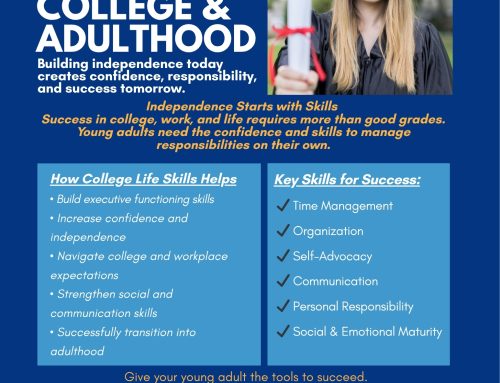
At the College Life Skills Program, our team of Doctoral and Master level professionals utilizes a series of strategies, services, and techniques to help young adults who are college bound, in college, and even after college succeed in and after their transition into independent life. We help teach them life skills such as emotional intelligence that can be generalized into the work world and in life to help them learn how to balance independent life on their own, as well as executive functioning skills, social skills, and the development of emotional maturity. If your young adult is struggling with life skills, such as being able to identify emotions in certain situations or the transition into adulthood, CollegeLSP has the tools to aid them in achieving such skills.
Dr. Eric J. Nach, Ph.D., M.Ed., A.S.D.C., is a Developmental and Behavioral Specialist who specializes in Autism, ADHD and related disorders. Dr. Nach is the founder of the College Life Skills Program where he and his team of professional’s help develop the Emotional Maturity, Executive Functioning, Life Skill and Social Abilities of college students and those high school students preparing for college. The CollegeLSP is a subsidiary program of the Support For Students Growth Center, located in Boca Raton, FL and providing services nationwide.
Rim, C. (2022, November 8). Emotional intelligence: Combatting the College Mental Health Crisis. Forbes. https://www.forbes.com/sites/christopherrim/2022/09/21/emotional-intelligence-combatting-the-college-mental-health-crisis/?sh=255944101b6c
Patil, Dr. D. Y. (2022, July 20). Importance of emotional intelligence in students. Dr. D. Y. Patil Arts, Commerce & Science College, Pimpri, Pune. https://acs.dypvp.edu.in/blogs/importance-of-emotional-intelligence-in-students#:~:text=A%20student%20with%20high%20EQ,empathetic%20to%20others%20around%20them.