Young adults are expected to make life-changing decisions from a young age but doing so can be more difficult in the world we have now. Being young during and after a pandemic is not easy. Quarantine was enough to make anyone become anxious and being college-bound or in college can add to that pressure. Young adults deciding what they want to do for the rest of their life is a choice that will follow them forever. College students are expected to get their degree and then get a job that correlates to it. Yet, even the thought of doing so can set a child back. Those with ADHD, Autism, Asperger’s, Learning Disabilities etc., do not always have the tools to feel confident in situations such as college or the workforce. This can cause an overwhelming sense of anxiety and/or fear. Since many students had experienced remote learning during the pandemic, returning to a regular work or learning environment can trigger this stress, therefore making them at risk for Failure to Launch. Students with various abilities already experience rudimentary executive functioning skills, and the pandemic only augmented the need for more support.
Experiencing anxiety as a college student is more common than most think. When asked what comes to mind, most people think of partying and forget about the stress. However, according to a study done on college students, “anxiety is the top presenting concern at 41.6%.” (APA, 2013). Fearing what is happening now, plus in the future can make students feel like they are drowning. The anxiety begins to build and build before creating resentment towards life after college. For instance, Harvard asked 54 graduates to explain their “personal experience transitioning from college to the professional world, and a few said “Exhausted; lost; anxious; and everything is a struggle.” (Molinsky and Pisman, 2019). Such negative examples emphasize one thing–anxiety. Feeling as if they are not ready to experience the professional world can hinder them from pursuing it, therefore spiraling them into Failure to Launch. In spite of that, becoming equipped with the right executive functioning skills can ease the anxiety that follows.
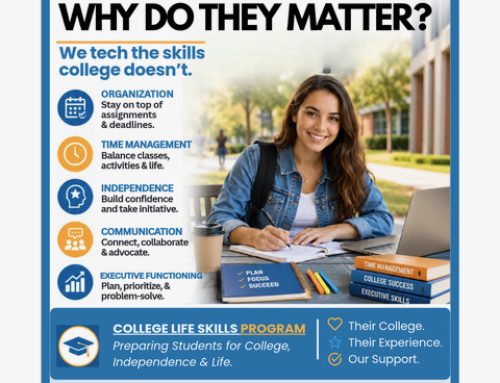
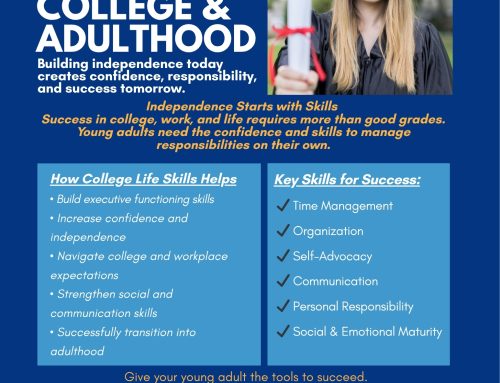
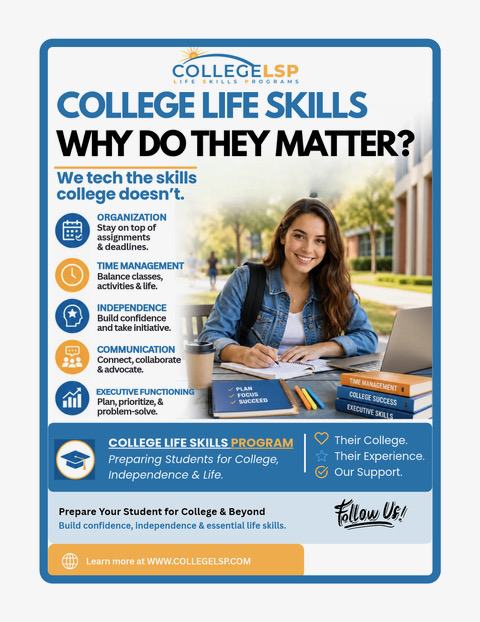
Walking into the workplace and knowing how to properly interact with your coworkers compared to your friends is an example of how proper executive functioning can ease stress. The fear of saying something inappropriate to your boss is enough to make anyone clam up. Plus, being fresh out of college only amplifies that. You are already young and new, so one mess-up feels like the end of the world. Even though everyone makes mistakes, the anxiety of doing so can make it even more likely. Messing up once can make a young adult so anxious about doing so again it can become a hindrance. Trial and error are a part of life. It is how we grow and understanding that it is normal is one of the first steps to overcoming fear and anxiety. At the College Life Skills Program, we acknowledge that. We help your young adult develop the tools needed to overcome and manage anxiety in situations such as work, school, with peers etc., with a program that utilizes evidence-based practices. From there, implementing creative strategies helps young adults develop these essential skills that allow them to feel prepared as they go into and after graduating college. When graduates need extra aid to gain the tools to overcome anxiety and stress, and to strengthen their executive functioning and social skills, the CollegeLSP is prepared to help.
Dr. Eric J. Nach, Ph.D., M.Ed., A.S.D.C., is a Developmental and Behavioral Specialist who specializes in Autism, ADHD and related disorders. Dr. Nach is the founder of the College Life Skills Program where he and his team of professional’s help develop the Emotional Maturity, Executive Functioning, Life Skill and Social Abilities of college students and those high school students preparing for college. The CollegeLSP is a subsidiary program of the Support For Students Growth Center, located in Boca Raton, FL and providing services nationwide.
American Psychological Association. (2013, June). College students’ mental health is a growing concern, survey finds. Monitor on Psychology. Retrieved June 26, 2022, from https://www.apa.org/monitor/2013/06/college-students#:~:text=Anxiety%20is%20the%20top%20presenting,relationship%20problems%20(35.8%20percent).
Molinsky , A., & Pisman, S. (2019, April 11). The biggest hurdles recent graduates face entering the workforce. Harvard Business Review. Retrieved June 26, 2022, from https://hbr.org/2019/04/the-biggest-hurdles-recent-graduates-face-entering-the-workforce