Time management is the key to getting things done. It is easy to become sidetracked by unimportant tasks that do not help you or your children reach desired goals without the proper time management. By following some of these strategies, you and your children will be able to navigate your time wisely. These strategies and “tools” will help you achieve your goals while decreasing stress levels and by making life easier and more enjoyable.
Urgent/Important Matrix
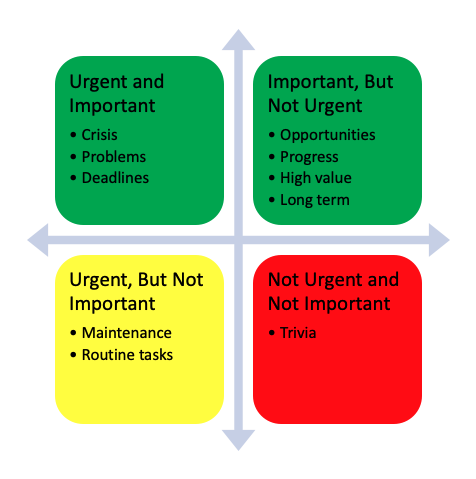
In order to manage your time, you need to determine the difference between urgent and important tasks. Urgent tasks are tasks that need to be done quickly, and important tasks are related to specific goals. Most tasks will be a combination of the two, such as urgent/important or urgent/unimportant. You need to place priority on important tasks, completing tasks that are both urgent and important first.
Unfortunately, we are often trapped by performing urgent tasks that are not important. They may be important to the people around you, but, they are distractions and interruptions that do nothing to help you meet your own goals. Important tasks should take priority because they are focused on specific goals. The urgent/important matrix will help you identify which tasks are urgent and which ones are important.
The Urgent/Important Matrix:
The 80/20 Rule
Many successful individuals recommend following the 80/20 Rule. The 80/20 rule states that only 20 percent of our actions are responsible for 80 percent of our successes. This means that it is necessary to discover the 20 percent of our actions that are the most effective. Focus on these actions once you discover them and make them your priorities.
The 80/20 Rule should be linked to your goals. Once you prioritize goals, you should spend most of your time working on the 20 percent of activities that you know will move you forward.
Utilize a Calendar/Agenda
Calendars/agenda’s are essential to effective time management. Calendars/agenda’s are familiar tools, but, they are not always used effectively. In school it is not uncommon for students to be instructed to use their agenda’s, however, students are not taught how to use them effectively, leading to improper use or avoidance. When using a calendar/agenda to manage time, it is important that you only use one. Given the different calendar/agenda options, it is easy to try to integrate different calendars, but you risk scheduling mistakes. You can choose from physical calendars, mid tech options like Day-Timer, and high-tech apps for your phone or tablet. Find the calendar that works for you and stick with it.
Calendar/Agenda Rules:
- Keep the calendar/agenda with you: Leaving the calendar behind means that you may forget to list something on it.
- List appointments and day events: Appointments require specific times. Events include birthdays, anniversaries, etc.
- Include assignments including homework, tests and projects.
- Set up reminders and multiple alarms if warranted.
- Avoid notes: Do not clutter your calendar. Have a separate section for notes.
- Include phone numbers/emails: While you should avoid clutter, phone numbers/emails and addresses may be useful.
- Parents; Do not assume that your child knows how to use their agenda/calendar effectively, they may need to be taught, just like any other skill.
Create a Ritual
Rituals can help improve time management. Rituals are repetitive actions, which do not need to be scheduled once they have become habits. For example, you do not think about brushing and flossing before bed or making coffee with breakfast. By creating rituals that are connected with goals, you will not have to schedule certain tasks. For example, if you get up at the same time every morning and exercise for 30 minutes, you will create a ritual. This ritual will become a habit over time.
You will not create a ritual overnight. For the first few months, you will have to be disciplined in your efforts. It takes time to create a habit. How long it takes a habit to form will vary according to each individual. There is no magic number. You will have to continue your quest until your ritual is complete.
Dr. Eric J. Nach, Ph.D., M.Ed., A.S.D.C., is a Developmental and Behavioral Specialist who specializes in Autism, ADHD and related disorders. Dr. Nach is the founder of the College Life Skills Program where he and his team of professional’s help develop the Emotional Maturity, Executive Functioning, Life Skill and Social Abilities of college students and those high school students preparing for college. The CollegeLSP is a subsidiary program of the Support For Students Growth Center, in Boca Raton, FL.