Fear. For some, it is something that drives them, but for those who are not so lucky, it can bring them down. It can be something that looms over an individual, making day-to-day life much harder than anticipated, which is why fear regulation is so important. Yet, it is much easier said than done. Trying to minimize the idea of what scares you is hard to do because even though you convince yourself it’s not as apparent as you may think, that fear always seems to be nagging in the back of your mind. Without the proper help when understanding what to do when fear interrupts successful goal attainment, it can lean more into denial, or in the opposite direction of anxiety, which is why it is so important to teach young adults getting ready for college and others the most valued ways to manage fear.
The first step into becoming proficient in fear regulation is understanding what exactly it is. Catherine Hartley and Elizabeth Phelps define fear regulation as “In active coping, fear is regulated through the performance of behaviors that reduce exposure to a fear-evoking stimulus. Finally, a fear memory can be disrupted after it is recalled through … behavioral manipulations that block its reconsolidation.” (Hartley and Phelps, 2009.) This explains how fear regulation is a thing all people have to learn. It is not a thing society is naturally gifted with, and that is okay, but it is important to try and prevent the stimuli that cause this fear. People will always have a fear, but this ability to suppress and regulate it may be more difficult for those with life challenges such as ADHD, Autism, Asperger’s, etc. than those who do not have such challenges. Adults with life challenges can be “highly sensitive,” making it much more difficult to fear regulate since they feel emotion at such a higher frequency than the rest of the population. “An absence of work, social success, and/or school can heighten this emotional strain” (ldpride.net, 2021). This is why when it comes to education, it is crucial students with life challenges do not drop out since it can supply a job, career, motivation and social interactions, and programs such as the College Life Skills Program can ensure just that.
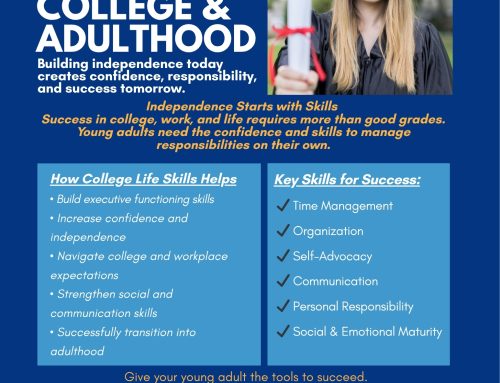
The CollegeLSP is a program that can help students with life challenges going into, or already in college, feel secure and ready to start the next chapter of their life, especially since more often than not, they will be away from home and may have minimal support. The inability to be the regulator of your child’s experience with fear is what makes letting them go so difficult. Yet, it doesn’t have to be. With the help of the CollegeLSP, they can be proficient in fear regulation. Breathing habits, visualization and relaxation techniques, finding what can ease you when scared, and understanding that fear is a completely normal emotion are only a few of tricks the CollegeLSP can teach an individual in order to not let fear overtake their life. Going out and experiencing life is supposed to be fun, especially when attending a college or university, which is why if you or your child is struggling with fear regulation, the College Life Skills Program is here to help.
Dr. Eric J. Nach, Ph.D., M.Ed., A.S.D.C., is a Developmental and Behavioral Specialist who specializes in Autism, ADHD and related disorders. Dr. Nach is the founder of the College Life Skills Program where he and his team of professional’s help develop the Emotional Maturity, Executive Functioning, Life Skill and Social Abilities of college students and those high school students preparing for college. The CollegeLSP is a subsidiary program of the Support For Students Growth Center, located in Boca Raton, FL and providing services nationwide.
admin1. (2021, September 14). Top 5 emotional difficulties of people with learning disabilities. Ldpride.net. Retrieved February 24, 2022, from https://www.ldpride.net/2021/08/16/top-5-emotional-difficulties-of-people-with-learning-disabilities/
Hartley, C. A., & Phelps, E. A. (2009, August 26). Changing fear: The neurocircuitry of emotion regulation. Nature News. Retrieved February 24, 2022, from https://www.nature.com/articles/npp2009121#citeas