It’s okay because I know my parents will always send me money…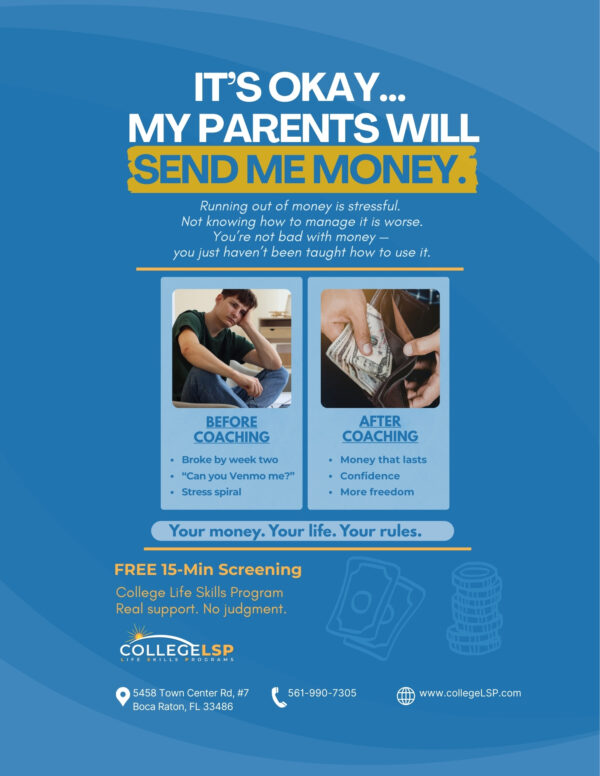
For William, being responsible with money never crossed his mind. If he wanted something, his parents got it for him, and when he needed money, they always gave it to him. Now that he was off to college, it didn’t cross his mind that this would change. He thought that if he asked, his parents would still give him as much as he needed, but that wasn’t the case. Instead, they gave him a set amount of money each month and expected him to manage and budget that money himself. Yet, what they didn’t realize was that their son had absolutely no idea how to do that.
Instead, William spent his entire months budget on video games, and when he called his parents asking for more money, they gave it to him. Although they explained he needed to be more responsible this time around, as the next few months came and went, William continued the same pattern. He would irresponsibly spend his money, ask his parents for more, and they would give it to him. After the 5th time, Williams parents realized that they weren’t helping their son but rather enabling his bad money management by never letting him face the consequences of his actions, so the next time, they did. However, this didn’t help William. Instead, it hindered him, causing him to quickly develop anxiety about money, and as time went on and nothing got better, they reached out to the College Life Skills Program for help.
Worried their son would be unable to manage his money properly, Williams parents contacted the College Life Skills Program for help. There, they met with a coach weekly so they could try and figure out a way to help William not only understand the importance of being able to manage his money but feel confident with his ability to be able to do so on his own in an age-appropriate manner. His parents didn’t want to have to micromanage, and William, now being a young adult, wanted support that wasn’t his parents, so he met with a counselor who taught them the necessary skills needed to be able to efficiently manage his money. As William received this coaching, with a level of accountability, his ability to manage money became far less difficult.
The transition from dependence to independence can be difficult, especially when it comes to managing money. Knowing how to budget so you have enough money for transportation, food, hygiene products, leisure, and overall life is a big change for many, and sometimes it may be the first time they are doing it all on their own. They may have never had to worry before about paying bills on time, managing a credit card, saving money for activities, etc., and now they are faced with having to manage that alongside all their other newfound responsibilities. Money management is a skill that is important for them to grasp, but young adults still may find it hard to prioritize the responsible spending over the more ‘fun’ kind. Instead of setting money aside for savings, rent, gas, soap, etc., they may spend it on video games, going out with friends, and other non-essentials. This doesn’t mean all their money has to go towards ‘adult’ things. Rather, they need to know when it is time to be responsible, and when they can spend a little extra.
Understanding how credit cards work, how to budget, not spend more than you make, and overall responsible money habits is crucial for young adults’ success while being independent. If not, they may find themselves in a cycle of poor spending and debt before they even get started. Utilizing things such as budget planners, setting aside certain amounts of money for their savings, and setting reminders for payments so they do not miss one are some ways young adults can better their money managing skills. However, it can be difficult to do on their own. That’s why we at the College Life Skills Program help them not only develop these skills but continue to utilize them by keeping them accountable while also providing the support they need to feel confident in their ability to do so.
Our team of Doctoral and Master level professionals utilizes a series of highly individualized strategies, services, and techniques to help young adults who are college bound, in college, and even after college succeed in and after their transition into adult life. We help teach them skills such as money management so they can be successful in the real and work world, help them learn how to balance independent life on their own, and other life, executive functioning, social skills, and emotional maturity. If your young adult is struggling with the transition into college and adulthood, CollegeLSP has the tools to aid them in achieving and generalizing such skills.
Click here and call now to schedule your FREE 15-minute individualized screening.
Dr. Eric J. Nach, Ph.D., M.Ed., A.S.D.C., is a Developmental and Behavioral Specialist who specializes in Autism, ADHD and related disorders. Dr. Nach is the founder of the College Life Skills Program where he and his team of professional’s help develop the Emotional Maturity, Executive Functioning, Life Skill and Social Abilities of college students and those high school students preparing for college. The CollegeLSP is a subsidiary program of the Support For Students Growth Center, located in Boca Raton, FL and providing services nationwide