But what if I say the wrong thing?
For one young woman, this is all she can think about when away at college. Although her social skills weren’t her main issue, being able to communicate her emotions to her roommate when something was bothering her was clearly lacking. As time went on, the young woman realized that her parents were usually the ones to voice her concerns for her. Whenever she was upset, annoyed, or feeling any sort of negative emotions, she would usually just tell her parents and they’d fix it, but now that she was on her own, she quickly realized she lacked the ability to properly communicate her feelings, especially when it came to her roommate.
Although her roommate never showed any hostility, the young woman was scared to upset her. She felt that since her communication skills weren’t the best that she had a high risk of saying things in a way she didn’t intend, so she didn’t say anything at all. As time goes on and her roommate continues to do little things that bother her like leaving dishes out and being too loud at night, her anger began to build and build, yet, she still didn’t say anything. Instead, she let her fears of not being able to properly communicate continue to stop her from making her dorm a comfortable living environment, and eventually she began to think maybe college wasn’t for her. She felt as if having to live with someone and communicate her more negative feelings with them on her own was too stressful so when she came home for the summer, she told her parents she didn’t want to return, and when they asked why, she told them she just didn’t like it. However, when she eventually got a job, she could only keep it for a few weeks since she had to communicate not only with her co-workers, but customers constantly, and when she struggled to do so it showed that her communication issues weren’t just affecting her in college, but everywhere.
Late high school and college are typically where most students learn when and where is the right time to speak but having communication skills is so much more than just being able to hold a conversation. It is having the ability to express one’s emotions when something is bothering them or being able to voice your opinion in a situation where it may be difficult to in an appropriate way. Yet, this skill is not typically taught in school, resulting in many people lacking communication abilities, especially those with neurodivergencies.
After college, young adults are typically expected to be employment-ready, however, employers state that many are missing skills that they find important when looking for an employee. A source explains how “Three out of four employers say that they have a hard time finding graduates with soft skills such as communication…and when compared to other soft skills, communication is the highest in demand at 77%.” (Wilkie, 2019). According to Wilkie, there is a high demand for workers with such skills because we cannot program machines to have communication skills that directly mirror a human. Only we as people can give such authentic human contact, but even though it is thought to be only a trait of humans, many seem to lack it, especially those with neurodivergences. According to another source, “50% to 90% of people with [learning differences] have communication difficulties.” (Jones, 2002). These numbers mean that at least if not more than half of those with such differences find communication skills hard to grasp, but it does not mean it is impossible to teach them.
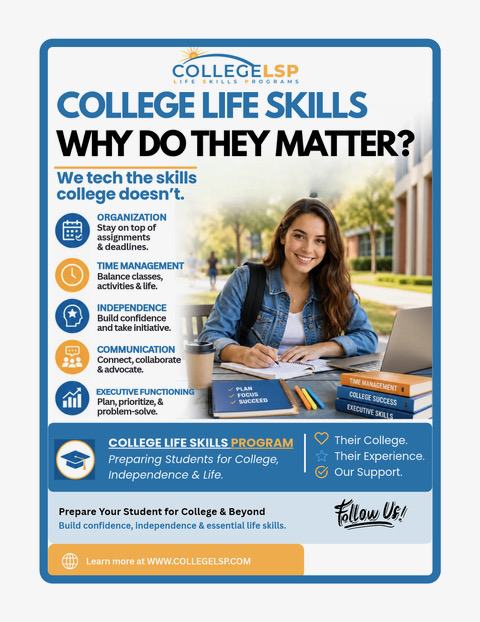
At the College Life Skills Program, our team of Doctoral and Master level professionals utilizes a series of strategies, services, and techniques to help young adults who are college bound, in college, and even after college succeed in and after their transition into independent life. We help teach them life skills such as proper adult level communication so they can be successful in the work world and in life as well as help them learn how to balance independent life on their own, and other executive functioning skills, social skills, and emotional maturity. If your young adult is struggling with life skills, such as being able to communicate in an age-appropriate way or the transition into adulthood, CollegeLSP has the tools to aid them in achieving such skills.
Click here and call now to schedule your FREE 20-minute individualized screening- $200 value
Dr. Eric J. Nach, Ph.D., M.Ed., A.S.D.C., is a Developmental and Behavioral Specialist who specializes in Autism, ADHD and related disorders. Dr. Nach is the founder of the College Life Skills Program where he and his team of professional’s help develop the Emotional Maturity, Executive Functioning, Life Skill and Social Abilities of college students and those high school students preparing for college. The CollegeLSP is a subsidiary program of the Support For Students Growth Center, located in Boca Raton, FL and providing services nationwide.
Wilkie, D. (2020, February 28). Employers say students aren’t learning soft skills in college. SHRM. Retrieved April 10, 2022, from https://www.shrm.org/resourcesandtools/hr-topics/employee-relations/pages/employers-say-students-arent-learning-soft-skills-in-college.aspx
January 2002 factsheet – imagine inclusion. (n.d.). Retrieved April 10, 2022, from https://www.imagineinclusion.co.uk/media/files/Communication%2002.pdf